

Medcare StaffingMedcare Staffing

  • Home
  • Clinicians
    • Job List
    • Submit Your CV
  • Facilities
    • Request Coverage
    • Necesito Cobertura
  • Government
    • Capability Statement 2023
  • BLOGS
  • MBN Podcast
  • About
    • Contact
    • Ratings & Reviews
    • FAQ
Call Us

Posts tagged “burnout”

  • Home
  • Posts tagged “burnout”

October 5, 2022

author: Ersilia Pompilio RN, MSN, PNP
The Best Ways to Combat Burnout and Enjoy a Healthier Work Life Balance.

“Working five days a week, nine to five. Charting patient information after work hours at home. Now my boss wants me to be on call for my patients two weekends a month. Oh wait, what about my husband and my 18-month-old child?” These were the protests left by a healthcare provider on a recent social media post. Burnout.

 Let’s face it, working as a healthcare provider is not getting any easier. It seems nearly impossible to pair that with raising a family, juggling friends and social obligations. It’s a perfect recipe for burnout.

In a survey conducted in 2021, 52% of US workers stated that they are experiencing burnout. Work from home employees or virtual workers said they are working “much more” than before the pandemic. Unplugging after work is a challenge for many workers, with 27% reporting that they keep working at home. Many workers state that working more hours is due to the increased pressures from management, customers, and clients.

Burnout

Burnout- It’s a Socio-Psychological Phenomena

Burnout can creep up on you slowly. One day you might wake up to find yourself transformed into a monstrous cockroach, much like the character Gregor Samsa in Franz Kafka’s famous play The Metamorphosis. Gregor’s transformation was blamed on his dreary job as a traveling salesman and his obligations to provide for his family. Basically, he was burnt out.

Believe it or not, burnout is considered a ‘syndrome,’ a socio-psychological phenomenon that includes physical, motivational, and emotional exhaustion. The cause: chronic occupational stress. The clinical picture of burnout is multifaceted. It’s not just about your job or your family. It’s also related to the role you are playing in society. Is your work and home life bringing you joy? Are you being a productive member in society? Are you living life unconsciously on someone else’s terms?

Negative Consequences

Burnout is a set of somatic and psychosomatic disorders which are symptoms of social dysfunction. Healthcare providers commonly suffer from burnout due to the dedication and increased levels of empathy felt for their patients.

Healthcare providers suffering from burnout are susceptible to increased medical errors and potentially higher malpractice rates. Poor work performance can also decrease patient satisfaction scores and lower quality care. Burnout can also have devastating effects with high healthcare staff turnover rates, increased alcohol and drug addiction, and a high risk for suicide.

Tensed surgeon with hand on forehead sitting in corridor of the hospital

Signs 

Exhaustion

Low emotional and energy levels are proceeding in a downward spiral. Healthcare providers may be running on fumes and asking themselves how long they can continue.

Depersonalization

Being detached from one’s mind, body, and mental processes. Subsequently, you may be observing your life from the outside. You may be using synoecism and sarcasm to talk about your patients. Emotionally you are unavailable to your patients and perhaps even your family.

Lack of Efficacy

Doubting the meaning of your work. You may question the purpose of your work, in addition, you may be critical of yourself, worrying that you may make increased errors.

Causes of Job Burnout

  • Chronic Work Overload. Daily increases in patients seen on a daily basis.  Nurses handle significantly higher ratios of patients per person at the bedside, creating unsafe staffing. Burnout is inevitable with work politics, personality clashes, workplace bullying, and sloppy management.
  • Work-Life Imbalance. Work may take up most of your time, leaving very little time spent on family and personal activities that satisfy you. 
  • Monotonous Environment. Albert Einstein coined the phrase, “Insanity is doing the same thing repeatedly and expecting different results.” When a job is chaotic and dull extra energy is needed to remain focused and motivated.
  • Unclear Role Expectations/ Lack of Support. Insufficient resources, inability to influence job scheduling, and lack of resources needed to do your job safely can increase burnout. Lack of social support on the job and at home  can also increase your risk for burnout.  
  •  Speaking a Non-Native Language On the Job. Having to speak in a language on the job that is not your native language can cause increased fatigue. Non-native speakers experience increased fatigue from having to constantly monitor their actions on the job.

Recognize the Physical Signs Before It’s Too Late

Burnout may creep up on you slowly. You may start missing work deadlines, delay updating your licensing credentials, and attending continuing education courses to update your certificates. Recognizing the symptoms of burnout before you start turning into a “Kafka cockroach,” is key to shifting your reality and staying focused on the Job and your life. Some physical symptoms of burnout include insomnia, headaches, chronic fatigue, stomach aches, isolation, increased irritability, struggling with daily tasks, and depression. Ignoring physical signs of burnout may, in time, lead to more significant physical and mental health issues. These include elevated blood pressure, type 2 diabetes, low immune system, and increased susceptibility to various other illnesses.

Tips to Stop Burnout

Re-Evaluate Your Life

Taking a self-inventory of your personal and professional goals is an excellent way to evaluate your life for balance. Some questions you can ask yourself include: Are you happy at your current Job? Additionally, what changes can you make to increase your happiness and satisfaction with your work? Are you working at home once your work day is complete? Can you disconnect easily from work and spend quality time with family and friends?

Better Sleep

Examine your sleep hygiene to optimize your sleep cycle. All things considered, treating sleep as a priority in your life is crucial to combating burnout.

Exercise

Various aerobic exercises like running can help increase mental focus and clarity. New research suggests that aerobic exercise helps you to recover from mental exhaustion and burnout.

Take a Vacation

Vacations can provide you with mental and physical rest. If you cannot take a whole one-week or more extended vacation, ‘microvacations’ may be a solution. Microvactions like a ‘normal’ vacation offer a change of scenery, even if it’s just for one day. They can reinvigorate your senses by sitting on a local beach, going on a hike, or sitting at a trendy café people watching. It’s best to be mindful when taking either a vacation or a microvacation so that you do not pick a venue that may trigger you to work.

Mental Health

The best therapies to help combat burnout include: psychotherapy and cognitive behavioral therapy (CBT), physiotherapy, pharmacotherapy, music therapy, hypnotherapy, and mind-body therapies. Telehealth services for mental health are also an option. They are gaining in popularity and are easier to access.

Creative Outlet

Studies show that engaging in creative outlets like music, visual arts therapy, movement-based creative expression, and expressive writing reduce psychological and physiological effects of burnout.

Mindfulness

The best way to start practicing mindfulness is to pay attention to something you do daily. Stopping in the middle of your day to take deep breaths can also bring you greater awareness of your surroundings. Courses on mindfulness-based stress reduce stress and burnout.

Start a New Adventure and Give Locum Tenens a Shot

Considering your options in your current work-life situation is key to combating burnout. Maybe you need to make a change and see new places. MedCare Staffing can provide a change of scenery, potentially clearing away the burnout in your work life. Click here to speak to a staffing representative today.
September 2, 2021

author: MedCare Staffing
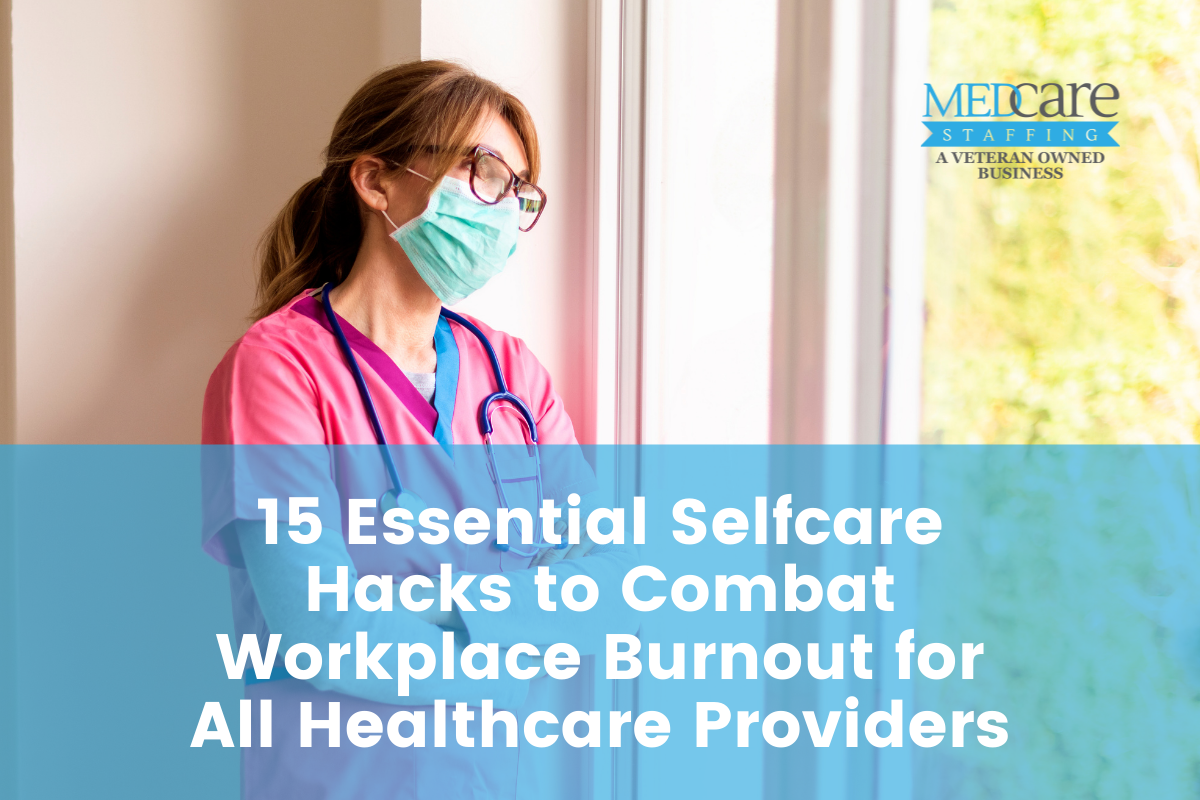
15 Essential Selfcare Hacks to Combat Workplace Burnout for All Healthcare Providers

Workplace burnout in healthcare has been going viral for quite a while. Covid-19 only exacerbated burnout symptoms suffered by many healthcare providers. Could self-care really be the answer to keep burn out symptoms at bay?

What is burnout?

Emotional, mental, and physical exhaustion caused by high amounts of long-term stress is what burnout is all about. American psychologist Herbert Fruedenberger started using the term ‘burnout’ in the 1970’s when he was describing the severe stress and high ideals he noticed being exhibited by nurses and doctors. Fruedenberger further concluded that many healthcare professionals, who sacrifice themselves to care for others, were exhausted, listless, and unable to cope.

Highest risk for burnout

According to various studies, 35% to 54% of healthcare providers suffer from burnout. Approximately 50% of American Physicians  alone suffer from burnout. Due to the increased stress levels and emotional strain, healthcare professionals are in the highest risk group to struggle with workplace burnout.

Burnout and the brain

Believe it or not burnout can change the brains anatomy. Chronic psychosocial stress from burn out can damage a person’s personal and social functioning and overwhelm cognitive functioning as well as the neuroendocrine system.

A study found that people who suffered from workplace burnout had a large amygdala along with brain areas linked to emotional distress. The more stress a person reported in their work life, the weaker the connectivity between brain regions appeared on their MRI’s. Further studies done on occupational stress was linked to reductions in gray matter in the hippocampus as well as cortical thinning which effects memory, attention and emotions.

Signs and symptoms of workplace burnout

Burnout is a medical disorder and has its own ICD 10 code ICD-10 (Z730.0-Burn-out state of vital exhaustion). It is imperative that healthcare providers recognize the signs and symptoms of burnout before potentially life-threatening mistakes can occur. Signs and symptoms of burn out  include:

  • Feeling sinical
  • Having resentments towards your workplace and patients
  • Feeling helpless
  • Low energy levels
  • Reduced productivity
  • Feeling tired and drained
  • Frequent illnesses like cold or flue
  • Unclear job expectations
  • Loss of motivation or moral
  • Procrastination
  • Self-isolation
  • Change in appetite
  • Inability to sleep
  • Poor eating habits
  • Self-medicating with alcohol or other substances
  • Lack of social support
  • Work life imbalance
  • High blood pressure

15 Selfcare hacks to combat burnout

  1. Know your breaking point

            To avoid getting to the “burnout” breaking point, it’s best to stop and do a self-    evaluation of how you are feeling. Do you keep getting triggered in a negative way by            your spouse, children and or dog? Are you having trouble focusing and concentrating?            It’s probably a             sign to take a day off.

  • Re-evaluate your goals

            Is your work bringing you passion and fulfillment? Do you dread waking up in the             morning to go to work? It’s best to write a list of ‘life goals’ and perhaps challenge      yourself by taking a creative course like stand-up comedy or improvisation. Believe it or             not, stand-up comedy and improvisation classes can help make your work life fun and            entertaining.

  • Take a vacation

            You do not have to take a lengthy vacation trip somewhere far far away. You can always plan a staycation where you live and focus on self-care activities full of exercise, mediation, and massages with a focus on relaxation.

  • Change your environment

Your personal environment which includes work colleagues, friends, family, personal habits and where you live can all impact your daily life. Sometimes you must move out of a negative space and move into a more positive one. Maybe you have to get rid of negative co-workers and colleagues who bring you down.

  • Find the “Magic” in your daily life

            Finding the ‘magic’ in your everyday life can help to alleviate burnout and give you a        more positive outlook on life. Take pleasure in watching sunsets and sunrises. Talk to a             new person every day. Take a minute and smell the flowers before you start your day.

  • Take a nap

            Studies show that a short nap in the afternoon enhances mood, improves job       performance, makes you alert and eases stress.

  • Exercise

            Exercise helps to increase your endorphins which puts you in a better mood. Taking a      brisk walk on your lunch break can help you finish off your day on a happier note.

  • Follow your passion

            What do you love to do? Have you explored areas that add a spark to your daily life?       You can develop a skill in a particular area and use it to contribute to something beyond   yourself to make your life much more fulfilling.

  • Find a creative outlet

            Dancing, doodling, and coloring are all great creative outlets. A creative outlet helps you             to express your feelings and ideas in a positive way.

  1. Practice mindfulness

            Developing a mindfulness practice helps you to be aware of your thoughts and feelings   without interpretation or judgment. Mindfulness brings greater relaxation to the body      and mind.

  1. Meditate daily

            Daily meditation helps to decrease stress, have better focus, as well as decreasing           negative emotions.

  1. Organize your space

            Letting go of things that no longer serve a purpose in your life can create a massive shift.             Placing things in easy to find spaces helps to decrease stress.

  1. Practice positive self-talk

            Positive self-talk makes you feel good about yourself. Waking up in the morning and        greeting yourself in the mirror can have a tremendous positive effect on the rest of your   day. Creating an optimistic voice in your head encourages you to look at the bright side           of things picking yourself up when you fall.

  1. Start a gratitude journal

            Giving thanks and counting blessings helps you get better sleep, lowers stress, and           improves relationships. Starting a gratitude journal and outlining 3 things in your life you    are grateful for everyday can also help you decrease daily workplace burnout and give          you a more positive outlook in life.

  1. Buy yourself some flowers.

            Flowers brighten up any space. Don’t wait for someone to buy you flowers start a            weekly flower budget. This will not only brighten up your space but will also brighten up your mood and put a smile on your face.

Dr. Richard Gunderman, professor of Radiology at Indiana University, explains that “the incremental onset of burnout is due to the accumulation of hundreds of tiny disappointments.” Burnout suffered by healthcare providers can have negative effects on patient care.

MedCare Staffing places physicians, advanced practitioners, pharmacists and dentists in locum tenens positions and permanent jobs.

If your current work situation causing you burnout? Stop those hundreds of tiny disappointments today and change your work environment by calling MedCare Staffing  (888)474-3380 and book your next Locum Tenen assignment by clicking here.

Medcare Staffing

© Medcare Staffing. All Right Reserved 2018. Site Created by Dash Digital Studio